
From the decision:
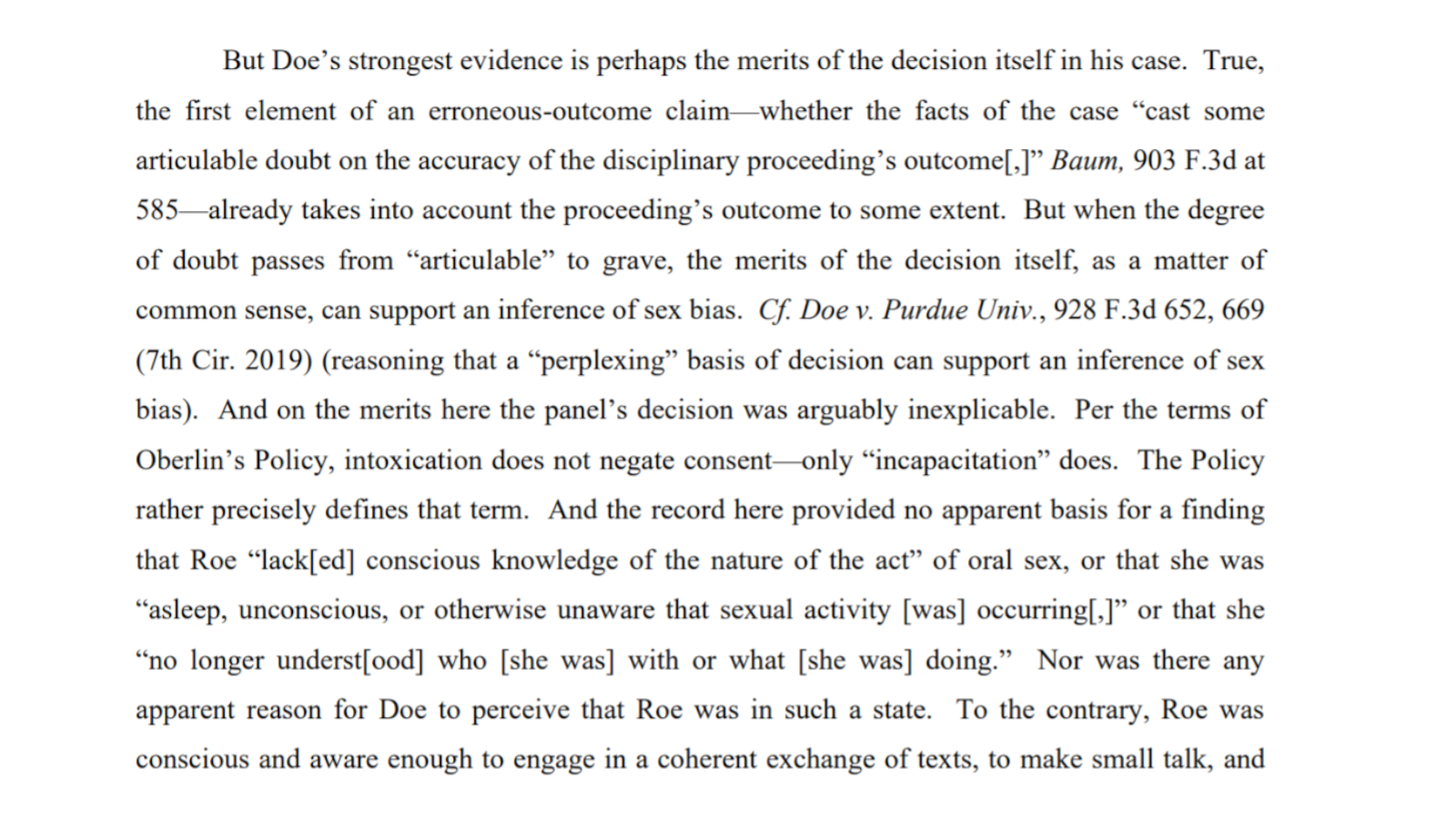
Doe’s strongest evidence is perhaps the merits of the decision itself in his case. True, the first element of an erroneous-outcome claim—whether the facts of the case “cast some articulable doubt on the accuracy of the disciplinary proceeding’s outcome[,]” Baum, 903 F.3d at 585—already takes into account the proceeding’s outcome to some extent. But when the degree of doubt passes from “articulable” to grave, the merits of the decision itself, as a matter of common sense, can support an inference of sex bias. Cf. Doe v. Purdue Univ., 928 F.3d 652, 669 (7th Cir. 2019) (reasoning that a “perplexing” basis of decision can support an inference of sex bias).
And on the merits here the panel’s decision was arguably inexplicable. Per the terms of Oberlin’s Policy, intoxication does not negate consent—only “incapacitation” does. The Policy rather precisely defines that term. And the record here provided no apparent basis for a finding that Roe “lack[ed] conscious knowledge of the nature of the act” of oral sex, or that she was “asleep, unconscious, or otherwise unaware that sexual activity [was] occurring[,]” or that she “no longer underst[ood] who [she was] with or what [she was] doing.”
Nor was there any apparent reason for Doe to perceive that Roe was in such a state. To the contrary, Roe was conscious and aware enough to engage in a coherent exchange of texts, to make small talk, and to reason that, “[w]e were no longer clothed and I felt that if anything was to continue happening, I wanted a condom.”
Thus, on this record—and making all inferences in Doe’s favor at this stage of the litigation—one could regard this as nearly a test case regarding the College’s willingness ever to acquit a respondent sent to one of its hearing panels during the 2015-16 academic year.
Key language: “when the degree of doubt passes from ‘articulable’ to grave, the merits of the decision itself, as a matter of common sense, can support an inference of sex bias.”
Read the full decision in our Title IX Lawsuits Database.
Thank You for Reading
If you like what you have read, feel free to sign up for our newsletter here:
About the Author
Related Posts



From the decision:
Doe’s strongest evidence is perhaps the merits of the decision itself in his case. True, the first element of an erroneous-outcome claim—whether the facts of the case “cast some articulable doubt on the accuracy of the disciplinary proceeding’s outcome[,]” Baum, 903 F.3d at 585—already takes into account the proceeding’s outcome to some extent. But when the degree of doubt passes from “articulable” to grave, the merits of the decision itself, as a matter of common sense, can support an inference of sex bias. Cf. Doe v. Purdue Univ., 928 F.3d 652, 669 (7th Cir. 2019) (reasoning that a “perplexing” basis of decision can support an inference of sex bias).
And on the merits here the panel’s decision was arguably inexplicable. Per the terms of Oberlin’s Policy, intoxication does not negate consent—only “incapacitation” does. The Policy rather precisely defines that term. And the record here provided no apparent basis for a finding that Roe “lack[ed] conscious knowledge of the nature of the act” of oral sex, or that she was “asleep, unconscious, or otherwise unaware that sexual activity [was] occurring[,]” or that she “no longer underst[ood] who [she was] with or what [she was] doing.”
Nor was there any apparent reason for Doe to perceive that Roe was in such a state. To the contrary, Roe was conscious and aware enough to engage in a coherent exchange of texts, to make small talk, and to reason that, “[w]e were no longer clothed and I felt that if anything was to continue happening, I wanted a condom.”
Thus, on this record—and making all inferences in Doe’s favor at this stage of the litigation—one could regard this as nearly a test case regarding the College’s willingness ever to acquit a respondent sent to one of its hearing panels during the 2015-16 academic year.
Key language: “when the degree of doubt passes from ‘articulable’ to grave, the merits of the decision itself, as a matter of common sense, can support an inference of sex bias.”
Read the full decision in our Title IX Lawsuits Database.
Thank You for Reading
If you like what you have read, feel free to sign up for our newsletter here:
More from Title IX for All

Advisors for Accused Students
We can help you craft and execute a defense strategy at any stage—from report to investigation to adjudication—with the goal of achieving the best possible outcome.

Accused Students Database
A feature-rich database of lawsuits by accused higher ed students alleging schools violated their rights while investigating sexual misconduct claims.